

Disclaimer: This information is for informational purposes only and should not be considered financial advice. The author assumes no responsibility for any investment losses incurred based on the information provided. Before making any investment decisions, you should conduct your own due diligence and consult with a qualified financial advisor.
Naspers

Company Background
Naspers' Historical Evolution: Founded as De Nasionale Pers in 1915, the company initially focused on newspaper acquisitions. The strategic expansion beyond the Cape Province in 1917 marked the beginning of Naspers' national footprint. Over the years, the company delved into diverse sectors, including publishing, book publishing, and television broadcasting.
International Expansion and IPOs: The formation of pay-TV service M-Net in 1986 was a pivotal move, leading to the establishment of sister companies MultiChoice and M-Web. Naspers' entry into the digital era gained momentum with the launch of web portals and online retail platforms. The company's IPO on the Johannesburg Stock Exchange in 1994 and its Level I ADR listing on the London Stock Exchange further signaled its growing presence on the global stage.
Digital Business Focus: As the 21st century unfolded, Naspers embraced the digital age. The acquisition of a substantial stake in Tencent in 2001 marked a turning point, catapulting Naspers into the realm of global digital investments. The subsequent years witnessed the creation of Prosus, the listing of which solidified Naspers' position as a major player in the global internet economy.
Valuation
Market Cap: ~$29.01 billion
Net Asset Value (NAV): $49.6 billion
Estimated Discount to NAV: ~41% (based on current market cap)
*taken from (https://www.naspers.com/investors/investing-in-naspers/net-asset-value)
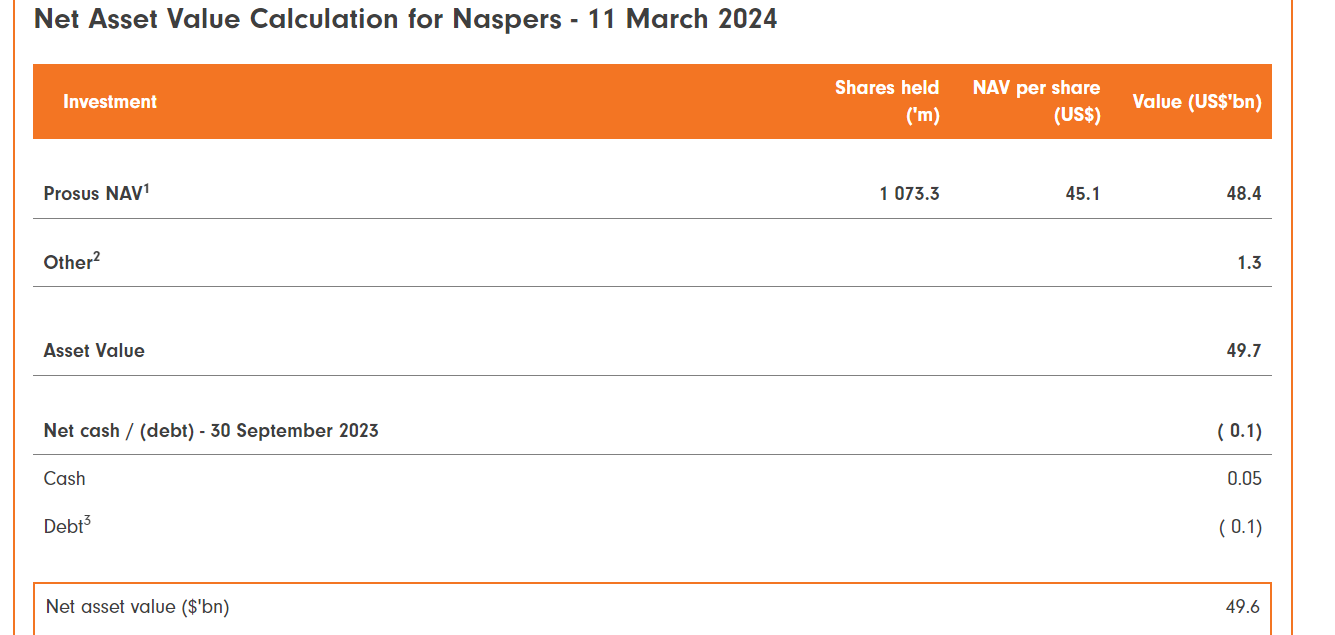
Naspers owns 41.83% of Prosus ( according to Tikr terminal’s data)
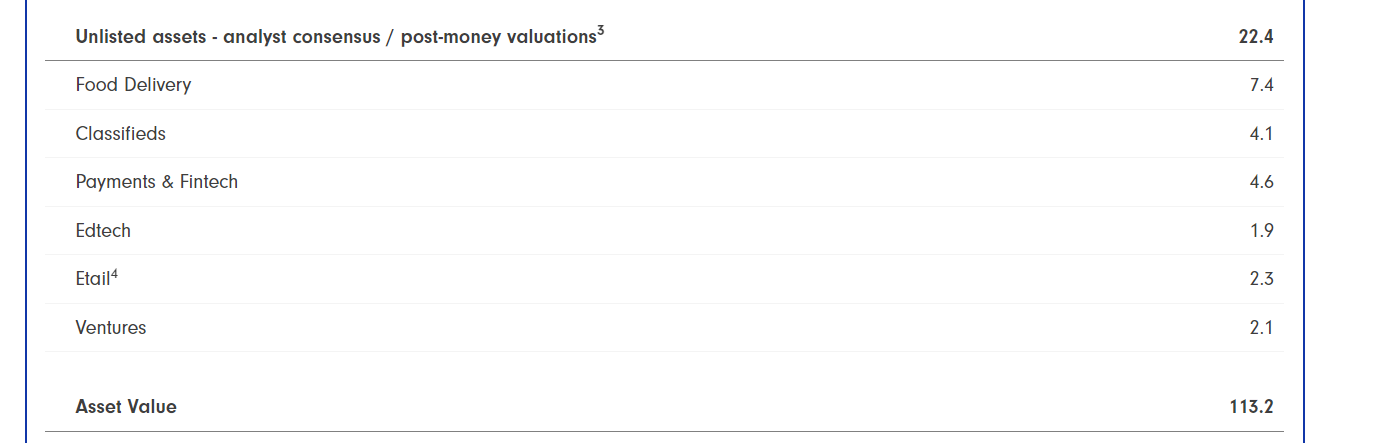
Premise for Opportunity
Heavily Protected Downside: The current valuation presents investors with a compelling proposition, offering substantial assets at a price that provides a considerable margin of safety. Naspers' diverse portfolio, encompassing ventures in various sectors and its stake in Tencent, acts as a shield, mitigating potential downside risks. This defensive posture provides investors with a robust foundation and the potential for long-term value.
Net Asset Value (NAV) Growth Potential: Naspers' strategic ventures and its significant stake in Tencent contribute to the growth potential of its Net Asset Value (NAV). The company's ongoing investments in innovative businesses and technologies position it for future gains. As Tencent continues to thrive with its tech-focused and capital-efficient business model, the NAV is poised for sustained expansion. This growth outlook enhances the attractiveness of the investment opportunity. ( potential to buy a growing dollar for 40 cents)
Tencent's Strong Position and Growth Potential: Tencent, a cornerstone of Naspers' portfolio, enjoys a protected position in the market, fortified by a robust moat. With its focus on technology-driven solutions and a capital-light approach, Tencent remains well-positioned for future growth. As a key player in the global tech landscape, Tencent's potential expansion and innovation contribute significantly to Naspers' overall upside potential. Tencent has a fantastic business model for growth
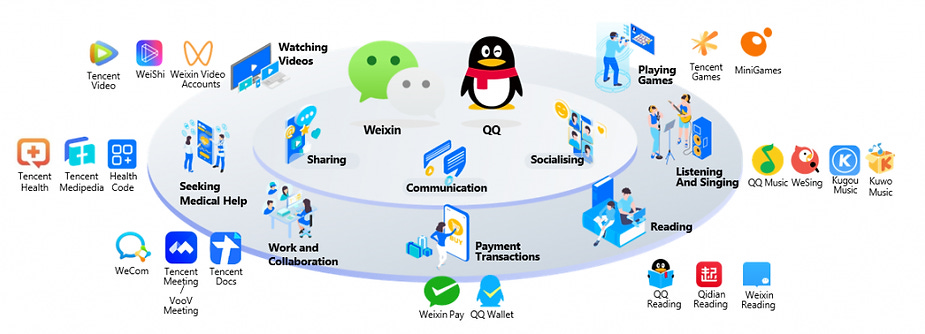
Tencent's crown jewels, WeChat, stands as a testament to its monopoly-like hold in China. WeChat, often referred to as the "everything app," goes beyond being a mere messaging platform; it integrates diverse functionalities, including social networking, mobile payments, e-commerce, and more. This all-encompassing nature has solidified WeChat's status as an indispensable part of daily life for Chinese consumers.

Pony Ma and his team, although lowkey, are one of the best management teams around, as demonstrated by their track record.
Tencent's Flywheel Effect: Very capital efficient
Diversification Beyond Core Services
Tencent's proactive strategy involves investments in diverse and periphery areas beyond its core services. For instance, strategic investments in companies like Didi, a ride-hailing app, showcase Tencent's commitment to expanding its ecosystem.
Integration with WeChat:
WeChat, Tencent's multifunctional platform, serves as the central hub for integrating these diverse services. By making these external services accessible within the WeChat ecosystem, Tencent creates a seamless and interconnected experience for users.
User Accessibility and Value Addition
The integration of services like Didi with WeChat adds significant value for users. They can access and utilize these services directly through the WeChat platform, creating convenience and enhancing the overall user experience.
Network Effects
WeChat's massive user base provides a substantial advantage. As services like Didi become accessible to millions through WeChat, it triggers a network effect. More users on WeChat mean more potential users for integrated services, contributing to their rapid growth.
Tencent's Role in Accelerating Growth:
Accelerated Growth for Partnered Services
Companies like Didi, benefiting from the integration with WeChat, experience accelerated growth. The instant access to a vast user base allows these services to expand more rapidly than they might have independently.
Mutual Reinforcement:
The success of integrated services, in turn, reinforces the attractiveness of the WeChat ecosystem. Users are more likely to stick with WeChat due to the added value from these integrated services, creating a positive feedback loop.
More Premise for Opportunity
Share Buybacks: Naspers' management demonstrates a proactive stance in maximizing shareholder value. The company leverages the discount to NAV as an opportunity to conduct share repurchases. This strategic use of capital reflects a commitment to capital allocation efficiency, showing that management is keen on enhancing returns and capitalizing on market mispricings.
Strong Management: The presence of Koos Bekker on the board of Naspers is a positive factor for the investment case. As the individual responsible for the strategic investment in Tencent, which turned out to be one of the most successful venture capital deals globally. Bekker brings invaluable expertise in capital allocation to the company (CEO at Naspers from 1997 to April 2014- created huge value for shareholders)
\
Counterarguments/ Points for concern
Capital Allocation Challenges:
While Naspers has historically demonstrated sound capital allocation strategies, recent decisions, such as reducing its stake in Tencent and investing in money-losing startups at premium valuations under CEO Bob van Djik's leadership, raise concerns. The effectiveness of the company's capital allocation practices was under question. For example, they invested in DeliveryHero, Swiggy and Foodpanda at quite questionable valuations. There is a new interim CEO now, and his capital allocation ability is not known yet.
Overreliance on Tencent?:
Approximately 72% of Naspers' Net Asset Value (NAV) is attributed to Tencent. This heavy dependence on a single company exposes Naspers to significant risks, as any adverse developments affecting Tencent could disproportionately impact Naspers' overall valuation and financial performance.
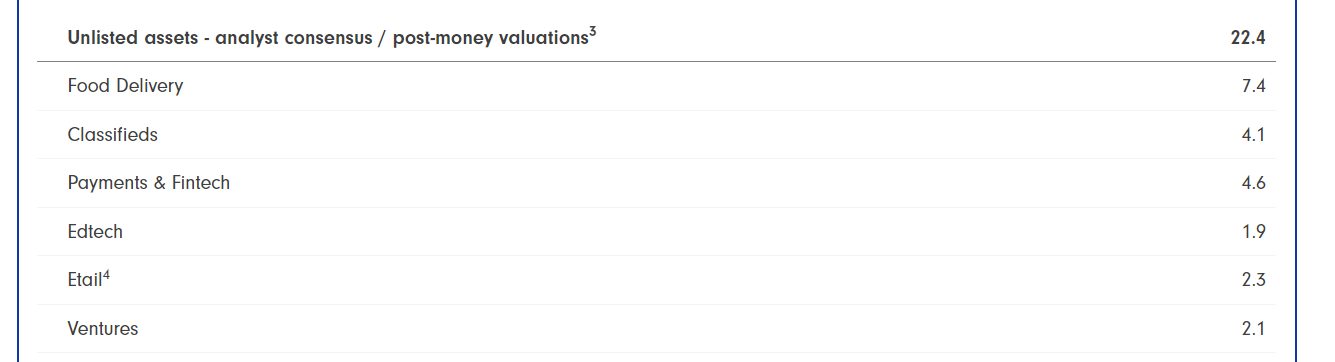
Uncertainty over value of unlisted assets
Naspers holds a portfolio of unlisted assets, and their valuations are subject to inherent uncertainties. Their unlisted asset might not be worth as much as they quoted, might be worth more in the future, need to analyze individual companies.The quoted values may be derived from various sources, including average estimates of sell-side analysts, post-money valuations on transactions without analyst consensus, and internal valuations. The reliance on estimates introduces the risk that these valuations may not accurately reflect the true worth of the unlisted assets.
Potential Holding Company Tax Implications: Minor risk
The sale of shares, especially in significant holdings like Tencent, may trigger tax implications for Naspers as a holding company. Investors need to consider the tax efficiency of such transactions and how it might impact the overall returns on investment.
Tencent-Related Risks
Scale Limitations and Growth Challenges:
Tencent's immense size poses a challenge to sustaining rapid growth rates. Achieving substantial growth from such a colossal base becomes increasingly difficult. Investors should be mindful of the potential limitations on Tencent's ability to compound at historically high rates, which may impact its overall contribution to Naspers' Net Asset Value (NAV).
Regulatory Scrutiny and Government Control:
The Chinese government's active supervision and control over technology companies, including Tencent, introduce regulatory risks. Recent regulatory actions, especially in the video game industry, indicate a tightening control environment. Uncertainty regarding future regulations may impact Tencent's operations and strategic initiatives. Tencent can sidestep some of it by going more for international markets but still, the influence of the government cannot be denied.
But I feel that internally, with the things they can control, Tencent’s management team are executing to the best of their abilities.
Final thoughts
A way to purchase a high quality business, with great management ( Tencent) at a discount
Even if other businesses are worth 0, still buying Tencent at a 15% discount to the price on the HKEX
well covered downside, and good but not fantastic upside (due to its size)